
How to read a peptide COA.
A Certificate of Analysis (COA) is a lab report for a specific production batch of peptide. A trustworthy COA names the batch, dates the test, states the methods used, and reports purity, content, and identity results. If a COA has no batch number, no date, or no method names, treat it as evidence of nothing.
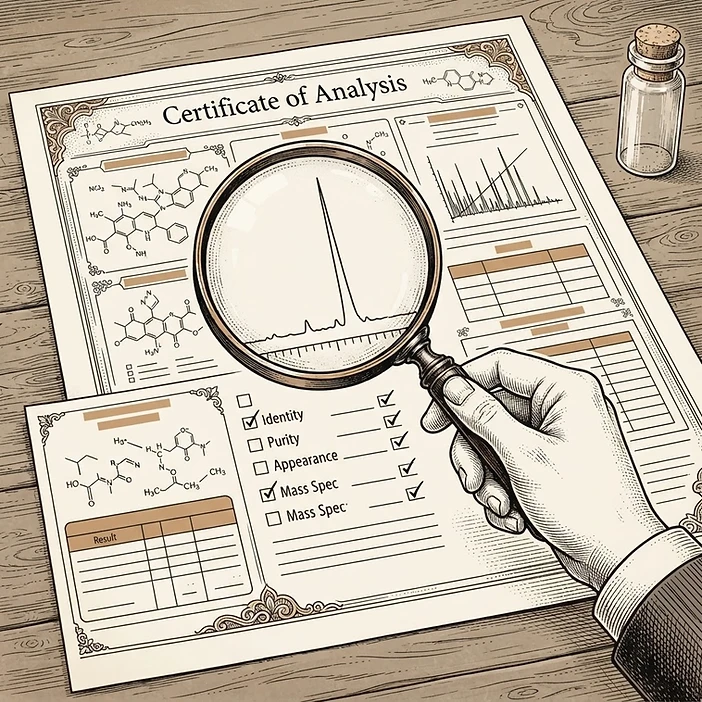
What a COA is
A Certificate of Analysis is a document issued by (or on behalf of) a manufacturer reporting the test results for a specific production batch. Its job is traceability: the batch number on the COA should match the batch number on the vial you hold.
Step 1: Match the report to the product
Before reading any results, confirm the document actually describes the vial in front of you:
- Find the batch or lot number on your vial. It is usually printed on the label or etched on the glass.
- Find the same number on the COA. A report with no batch number — or a number that does not match your vial — is not evidence about your material. It is evidence about someone else's.
- Check the dates. A report should carry a test or analysis date consistent with the batch timeline. A COA from three years ago says nothing about a vial filled last month.
- Confirm the product identity on the document. The product name, catalog number, and stated net amount should match your label.
For why this matters, see batch-specific COAs.
Step 2: Read identity, purity, and content as three different answers
The most common COA mistake is treating these three results as one number. They answer three different questions:
| Measurement | The question it answers | Typical method |
|---|---|---|
| Identity | Is this material actually the peptide named on the label? | LC-MS molecular weight; identity testing |
| Purity | Of the peptide-type material present, how much is the target peptide rather than related impurities? | HPLC area percent (purity) |
| Content | Of the total mass in the vial, how much is actually peptide rather than water and counterions? | Peptide content, typically by drying and weighing methods |
A vial can be ≥99% pure and still contain considerably less peptide than the label implies, because residual water and counterions (such as acetate) add mass that is not peptide. Conversely, an identity confirmation alone says nothing about purity. All three results together describe the material; any one alone is an incomplete picture.
What each test method demonstrates — and its limits
- HPLC purity measures the target peptide's share of peptide-related material (truncations, deletions, oxidation products). It does not measure non-peptide mass like water or salts, and it does not confirm identity. A purity number without a named method is not verifiable. See HPLC and peptide purity.
- LC-MS identity confirms the molecular weight of the main component. It does not quantify purity or content. See LC-MS.
- Endotoxin testing (LAL assay) detects bacterial endotoxin, a hazard for injectable-intended research material. A reported result is meaningful; the absence of the test is a gap. See endotoxin testing.
- Sterility testing (USP <71>) cultures a filtered sample in growth media for about 14 days to detect living microorganisms. It is a different test from endotoxin, and it samples only the tested portion. See sterility testing.
- Heavy metals (ICP-MS) checks elemental impurities such as lead, arsenic, cadmium, and mercury. See heavy metals.
An illustrative example (not a real report)
The lines below illustrate the kinds of fields a COA contains. This is not a genuine laboratory report:
| Illustrative COA line | What it tells you |
|---|---|
| Lot: EXAMPLE-240915-2 | The batch this report describes; match it to your vial's lot number |
| Appearance: white lyophilized powder | A physical description to compare against the material you received |
| Purity (HPLC): ≥99.0% | The main peak is ≥99% of peptide-related material, by that method |
| Molecular weight (LC-MS): 1,412.5 Da | Identity evidence — the measured mass matches the expected peptide |
| Peptide content: 88.2% | About 12% of the vial's mass is water and counterions, not peptide |
| Endotoxin: <0.10 EU/mg | An endotoxin result was measured and reported for this batch |
Verifying the issuing laboratory and the report
- A named laboratory is stronger evidence than "in-house testing" with no lab identified.
- Accreditation (for example, ISO/IEC 17025) indicates the lab's methods are audited against a recognized standard. It describes the laboratory's systems, not any single report.
- Where a vendor publishes a searchable COA library, confirm your lot appears in it. Some vendors also allow you to contact the issuing laboratory with the batch number — either path is real verification.
- A report with no signatory, no letterhead, and no contact information is easy to forge and hard to check. For how forged documents circulate, see fake COAs are real.
What's missing, and questions worth asking
If a COA omits results, treat the omission as information rather than an accident. Questions worth asking a vendor:
- "Is this COA batch-specific, or typical values?"
- "Which method produced the purity number?"
- "Is there an identity result (LC-MS) for this lot?"
- "Is peptide content reported separately from purity?"
- "Are endotoxin and sterility results available for injectable-intended material?"
- "Can I verify this report with the issuing laboratory?"
Using a COA analyzer — and its limits
Our COA analyzer helps you organize what a report says: it checks which of six core testing categories (identity, purity, content, endotoxin, sterility, heavy metals) appear on the document and explains what each reported result means in plain language.
It is equally important to know what an analyzer cannot do. Interpreting reported information is not the same as authenticating a document. An analyzer cannot confirm that a report is genuine, that it was issued by the named laboratory, or that it describes your batch — and it cannot establish that a product is safe from an uploaded report alone. Authentication still runs through batch matching and laboratory verification as described above. See batch-specific COAs.
Red flags on a COA
- No batch number, or a batch number that doesn't match your vial
- No test date, or an undated template
- "Typical values" language — meaning the numbers are not from your batch
- Purity claimed with no method named
- No laboratory or signatory identified
- Perfect identical numbers across batches — real batches vary slightly
For how forged documents circulate, see our article fake COAs are real.
How to verify
Cross-check the batch number against the vial. If the seller publishes a COA library, confirm your lot appears in it. Where possible, prefer sellers whose COAs include identity testing and endotoxin results rather than purity alone.
Questions. answered.
What should a peptide COA include?
At minimum: a batch number matching your vial, a test date, the lab's name, the testing methods, and results for purity, content, and identity. Endotoxin and sterility panels are a strong plus.
Can a COA be faked?
Yes. Templates are copied and numbers edited. Cross-referencing batch numbers and asking for method-level detail filters out most low-effort forgeries.
Can a COA analyzer tell me if a report is real?
No. An analyzer helps interpret the information a report contains, but it cannot authenticate the document, confirm the issuing laboratory, or establish that a product is safe from an uploaded report alone.